Understanding Nurse Practitioners Through the Journeys of Two Filipino Clinicians
When we think about healthcare teams, it is easy to stay inside the boundaries of our own profession. Physical therapists know physical therapy. Nurses know nursing. Physicians know medicine. Mental health clinicians know mental health. But patients rarely experience healthcare in neatly separated professional boxes.
A patient may see a primary care provider for pain, be referred to physical therapy for mobility and function, receive psychiatric care for depression or anxiety, and rely on several clinicians to communicate with one another along the way. That is exactly why PT MEAL launched Beyond PT—a segment that steps outside the physical therapy profession to better understand the healthcare professionals we work alongside.
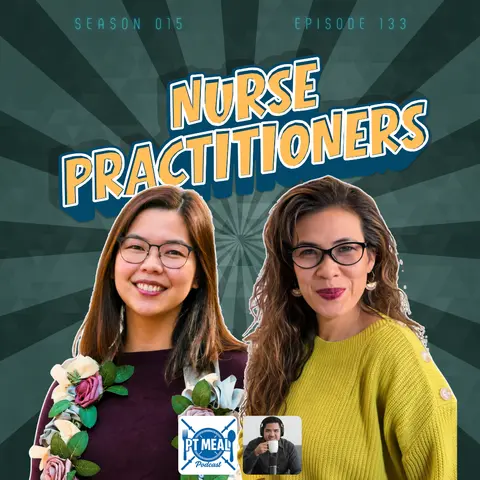
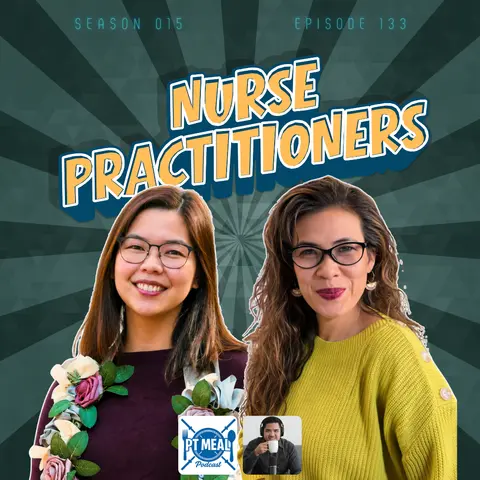
For the first episode, I sat down with two Nurse Practitioners: Lourie Jordan, PMHNP-BC, a board-certified Psychiatric Mental Health Nurse Practitioner, and Mary Catherine Espiritu Diaz, FNP-C, a board-certified Family Nurse Practitioner. Our conversation covered what Nurse Practitioners are, how their work differs from Registered Nurses and physicians, the different NP pathways, what it takes to become one, their personal journeys into advanced practice, and how Nurse Practitioners and physical therapists can work together more effectively.
Their stories also highlighted something bigger: professional growth is rarely a straight line.
So, What Exactly Is a Nurse Practitioner?
One of the first questions we tackled was probably the most basic—and most important: What is a Nurse Practitioner?
Both Lourie and Mica emphasized that Nurse Practitioners begin with nursing. They are Registered Nurses who pursue additional graduate-level education and advanced clinical training. That added preparation allows NPs to take on responsibilities beyond the traditional RN role, including evaluating patients, diagnosing conditions, ordering tests, prescribing medications within their scope, managing treatment, following patients over time, and referring to other healthcare professionals.
Mica described the contrast clearly. Registered Nurses are deeply involved in monitoring patients, administering medications, and providing ongoing nursing care, while the NP role adds greater responsibility for clinical evaluation, diagnosis, treatment planning, prescribing, follow-up, and referral.
At the same time, both guests were careful not to frame Nurse Practitioners as interchangeable with physicians. Their educational pathways are different, their professional foundations are different, and their scopes may be different. Lourie repeatedly returned to an important idea throughout the conversation: know your lane.
Advanced practice does not mean pretending to know everything. Good clinical care requires recognizing the limits of your expertise and knowing when another professional is better equipped to address a patient's needs. That lesson applies far beyond nursing. It applies to all of us in healthcare.
FNP, PMHNP, APRN: Why the Alphabet Soup Matters
"Nurse Practitioner" is not one single clinical role. There are different advanced practice pathways and different areas of specialization. Mary Catherine practices as a Family Nurse Practitioner, while Lourie practices as a Psychiatric Mental Health Nurse Practitioner.
Their scopes overlap in some areas, but their clinical focus is very different. As an FNP, Mary Catherine described working across the lifespan and functioning in a primary-care role: evaluating patients, ordering diagnostic tests, prescribing treatment, following patients, and referring to specialists or rehabilitation when appropriate.
Lourie's work as a PMHNP focuses specifically on psychiatric and mental health care. She evaluates and diagnoses mental health conditions, prescribes psychiatric medications, follows patients longitudinally, and collaborates with psychiatrists, primary care clinicians, and other healthcare professionals when a patient's needs extend beyond psychiatric practice.
Their discussion also touched on other advanced practice roles, including pediatric, adult-gerontology, and nurse anesthesia pathways. The important takeaway is that the letters after someone's name are not simply credentials. They tell us something about the population that clinician is trained to serve and the type of care they are prepared to provide.
Becoming an NP Is Not Simply "Going Back to School"
One of the most useful parts of the conversation was hearing the actual pathway into advanced practice. Both guests explained that becoming an NP begins with Registered Nursing and then progresses through graduate education, specialty training, clinical hours, certification, and state licensure requirements.
They described foundational coursework shared across advanced practice programs before students branch into more specialized preparation. For Lourie, that meant additional psychiatric and psychopharmacology education and clinical training in mental health. For Mica, Family Nurse Practitioner training meant preparation across the lifespan, including pediatric, adult, women's health, and geriatric care.
They also discussed board certification, state licensing, prescribing authority, and additional requirements associated with prescribing medications.
What became clear is that the journey involves much more than earning another degree. It requires intentionally moving from one professional identity into another.
Two Very Different Roads Into Advanced Practice
The educational pathway may have similarities, but their personal journeys could not have been more different.
Mica: From Reluctant Nursing Student to Family NP
Mica was refreshingly candid. Nursing was not originally her dream. She described entering nursing largely because of family influence, eventually moving to the United States and discovering that although nursing had not been her first choice, she no longer regretted the path.
Over time, the work became meaningful. Patients thanked her, and she saw that compassion and clinical care could genuinely affect people's lives. Becoming an NP later became partly about growth, opportunity, autonomy, and creating a better professional and family life.
She described reaching a point where staying in the same place no longer felt enough. If circumstances could not change around her, she could change what she was able to do within them.
That is a powerful career lesson:
Sometimes professional growth does not begin with a lifelong calling. Sometimes it begins with asking, “What can I do next with where I am now?”
Lourie: Computer Engineering to Psychiatric Mental Health
Lourie's route was even less linear. She did not begin in nursing at all. She originally studied computer engineering in the Philippines through a scholarship, later taught at a university, and eventually immigrated to the United States. After arriving in California, she found herself far from the technology-centered job market she had expected to enter.
Healthcare eventually became another path forward. She started as a psychiatric technician, returned to school while continuing to work, became a psychiatric technician, then a Registered Nurse, completed her bachelor's degree, and eventually pursued graduate education in psychiatric mental health nursing.
Much of that journey happened while working full-time. It was not a quick reinvention. It was a long sequence of incremental decisions: one class, one license, one promotion, one degree, one next step.
And eventually, she became the psychiatric clinician she had once imagined becoming through an entirely different route.
Her story is a reminder that a career can evolve without invalidating everything that came before it. Sometimes previous chapters become part of what makes the next one possible.
What Filipino Training and Migration Add to the Story
Both guests also reflected on the transition from the Philippines to American healthcare. Mica described practical differences from technology and clinical equipment to documentation, communication, measurement systems, and the highly litigious environment of U.S. healthcare.
But she also highlighted strengths she associated with her Filipino training and experience: adaptability, resourcefulness, and the ability to work with what is available. She described learning to improvise, adjust, communicate differently, and become comfortable participating more openly in interdisciplinary decision-making.
Lourie described another layer familiar to many immigrant healthcare professionals: language. Even after many years in the United States, she reflected on the mental effort of thinking in one language and speaking professionally in another. Phone calls, conversations with physicians, and explaining patient information could require rehearsal before the words came out.
Yet those uncomfortable experiences became part of her professional resilience.
For internationally educated clinicians, that experience may sound familiar. Clinical competence and communication confidence do not always develop at the same speed.
Where Do Nurse Practitioners and Physical Therapists Meet?
This was one of the most important parts of the conversation for PT MEAL because even though this episode focused on Nurse Practitioners, the real question for physical therapists is: How do our professions interact?
Mica described Family Nurse Practitioners as a kind of central point in many patients' care. A patient may initially present to primary care with pain, weakness, injury, or mobility limitations. The NP evaluates the patient, determines whether further investigation is needed, and may then refer the patient to physical therapy.
From there, the physical therapist contributes a different perspective—movement, function, mobility, activity, and rehabilitation. Mica also emphasized that she values the physical therapist's recommendations. That matters because interprofessional collaboration should not be one profession simply sending a patient to another. It should be a continuing exchange of information.
Physical Health and Mental Health Are Not Separate Lanes
Lourie's psychiatric perspective added another layer. Consider a patient with depression who becomes increasingly sedentary. Reduced activity contributes to deconditioning. Pain develops. Mobility becomes more difficult. Daily activity declines. That can reinforce social withdrawal and inactivity.
Now the patient's "mental health problem" and "physical problem" are no longer easily separated.
Similarly, some medications used to manage serious mental illness may affect movement, gait, tremor, balance, fatigue, or physical activity. For a physical therapist, knowing that a patient has schizophrenia, depression, or another psychiatric diagnosis—and knowing the treatment context surrounding that diagnosis—may change how we interpret what we see during rehabilitation.
Lourie emphasized that physical therapists should understand the whole patient rather than receiving only an isolated musculoskeletal complaint.
A shoulder is attached to a person. A gait problem exists within a broader medical, psychiatric, medication, behavioral, and social context.
That is where collaboration becomes essential.
Different Lenses, Same Patient
Toward the end of that discussion, one idea summarized the relationship well: healthcare professionals may be looking at the same patient through different lenses, but the goals often converge.
The Family NP may see chronic disease management. The PMHNP may see depression or psychosis. The physical therapist may see deconditioning, impaired gait, fear of movement, pain, or loss of independence. None of those perspectives necessarily compete with one another. Together, they can help explain the whole person.
That is one of the biggest lessons of Beyond PT. Understanding another profession does not diminish our own professional identity. It actually helps clarify what we uniquely contribute.
The Hardest Part of Professional Growth May Be Believing You Can Continue
The closing portion of the conversation moved away from credentials and scope of practice and became much more personal. When asked what they would tell their younger selves, both guests returned to persistence.
Mica's message was essentially: Hang tight. You still have a lot to learn, but you will make it.
She spoke about the difficulty of building a life in another country while balancing full-time work, school, parenting, family responsibilities, and cultural adjustment.
Lourie reflected on the hardships of growing up with very limited resources, immigrating, navigating language and culture, working while going to school, and continuing to move forward despite setbacks. Her answer centered on resilience.
Looking backward gave her evidence that she had already survived difficult chapters. That made future uncertainty less frightening.
Family, Purpose, Faith, Resourcefulness, and Resilience
During PT MEAL's final "Last Bites," both guests were asked what keeps their plates full and what ingredients make them who they are.
Their answers were remarkably consistent with everything they had shared earlier: family, purpose, faith, resourcefulness, resilience, and service.
For Lourie, family included not only biological relatives but also the people who support and walk through life with her. Her professional purpose was tied to helping people in her community access mental health care and giving back because she understood what it meant to grow up without resources.
For Mica, faith and family anchored her work, while resourcefulness represented one of the qualities she carried with her from the Philippines into American healthcare.
The Takeaway: There Is Usually a Next Step
At the end of the episode, both guests offered advice to people considering becoming Nurse Practitioners—or simply considering what comes next in their careers.
Their message was less about nursing specifically and more about movement: believe you can move forward, use the resources available to you, keep learning, and do not assume that the degree, job, or professional identity you have today must be the final version of your career.
Mica described growth as something that does not end with one degree. There can always be another step if you want one.
Lourie echoed the same belief: whether you believe you can move forward or believe you cannot, that belief will shape what you attempt next.
That feels especially appropriate for the first episode of Beyond PT because the purpose of this series is not to blur professional boundaries. It is to understand them better—to know what the people beside us actually do, to recognize where our responsibilities intersect, and ultimately, to become better teammates for the patients who depend on all of us.
Listen to the Episode
In this episode of PT MEAL Podcast: Beyond PT, Lourie Jordan, PMHNP-BC, and Mary Catherine Espiritu Diaz, FNP, discuss:
-
What Nurse Practitioners do
-
How NPs differ from Registered Nurses and physicians
-
Different NP and APRN pathways
-
Education, certification, and advanced practice training
-
Their journeys from the Philippines into U.S. healthcare
-
Family NP and Psychiatric Mental Health NP practice
-
Physical therapist–Nurse Practitioner collaboration
-
Advice for clinicians considering their own next professional step
Watch or listen to the full episode of PT MEAL Podcast: Beyond PT — Nurse Practitioners.
And after you listen, consider this question:
How well do you actually understand the roles of the healthcare professionals you work with every day?
Host / Creator
Johann is a physical therapist and a Board-certified Geriatric Clinical Specialist from the American Board of Physical Therapy Specialties. He has previously worked in home health, post-acute rehabilitation, and now in a forensic psychiatric hospital. He's passionate about patient care and spreading awareness about the physical therapy profession and practice. In his free time, he likes to chill and watch movies, or go out and enjoy nature.

May 17 is International Day Against Homophobia, Transphobia, and Biphobia